

A freshly unboxed ukulele rarely sounds right on its own. To tune a ukulele you first need a clear idea of which notes the four strings belong on and in what order. This guide explains the standard g-c-e-a tuning, why the low-sounding g actually sits an octave higher than you might expect, and how to work through it step by step.
The guide applies to soprano, concert and tenor ukuleles. Baritone and bass ukuleles use different notes, covered in their own chapter further down.
01Understanding the standard g-c-e-a tuning
Soprano, concert and tenor ukuleles are usually tuned to g-c-e-a. You count from the top string nearest to you (the fourth) down to the bottom string farthest from you (the first). The fourth string carries the g, followed by c, e and a.
A well-known memory aid for this sequence is the English phrase my dog has fleas, whose syllables match the notes g-c-e-a. You can sing it to yourself to keep the order in mind.
02Why the g sits an octave higher (high-G)
The defining feature of the ukulele is what is called re-entrant tuning. The g on the fourth string is not the lowest note of the instrument but sits an octave higher than you would expect from an ascending string order. This variant, called high-G, is the classic Hawaiian tuning. It produces the bright, sparkly sound associated with the ukulele, because the notes do not simply rise from low to high when you strum.
There is also the low-G alternative, where the fourth string is tuned an octave lower and becomes the lowest note of the instrument. This adds more bass and range but gives up some of the typical ukulele character. We go deeper into which option suits you, and what low-G is good for, in a dedicated article on the tenor ukulele.


03Tuning step by step
The easiest way is a clip-on tuner that you attach to the headstock. It picks up the string vibration directly and shows the detected note. Pluck a string, slowly turn the matching tuning peg and bring the display to the target note g, c, e or a. Approach the note from below where possible, starting slightly flat and tuning up, as this keeps the tuning more stable.
A tuning app on your smartphone, listening through the microphone, also works fine for getting started in a quiet room. With a bit of an ear you can tune to a reference note as well, for example the notes c, e, a and g from a piano or another instrument. Work through one string at a time and check all four notes again at the end, since tensioning one string can slightly pull the neighbouring strings.
| Body size | Tuning (4th to 1st string) | Note |
|---|---|---|
| Soprano | g-c-e-a | g as high-G, re-entrant |
| Concert | g-c-e-a | g as high-G, re-entrant |
| Tenor | g-c-e-a | high-G or low-G possible |
| Baritone | d-g-b-e | like the top four guitar strings |
| Bass | e-a-d-g | like a bass guitar |
04Baritone and bass: different notes
Not every ukulele is tuned to g-c-e-a. The baritone ukulele sounds lower and is tuned to d-g-b-e, exactly like the top four strings of a guitar. Anyone who already plays guitar will feel at home straight away. The bass ukulele in turn uses e-a-d-g tuning like a bass guitar.
The key thing is to know which body size is in front of you before tuning, so you do not accidentally force a baritone ukulele onto g-c-e-a. The same applies when buying strings: a set is always designed for a specific body size and tuning.
05Fresh strings and why they drift out of tune
New strings are impatient at first. They stretch over several days and keep losing tension, so the ukulele needs retuning more often until everything settles. This is normal and not a fault. You can speed up the process by gently pulling the strings away from the body after fitting them and then retuning.
Temperature and humidity also act on tension and therefore on tuning. A ukulele that has just come in from outside needs a short time to acclimatise before it stays stable. If the old strings sound dull or no longer hold tune, a fresh set matched to your ukulele body size is worth it.

With the sequence g-c-e-a in mind, a clip-on tuner and a little patience for fresh strings, the ukulele is cleanly in tune within minutes. To go further, the high-G versus low-G question is worth a closer look: there is a dedicated article on the tenor ukulele and its tuning. The strings that match your body size are in our ukulele string selection.
Frequently asked questions
Which notes is a ukulele tuned to?
What does high-G mean on a ukulele?
What is the best way to tune a ukulele?
Why does my ukulele keep going out of tune?
Ready for the next note
From entry-level models to the matching string set: find ukuleles and strings for every body size here.
Browse ukulelesBrowse ukulele stringsPassende Produkte
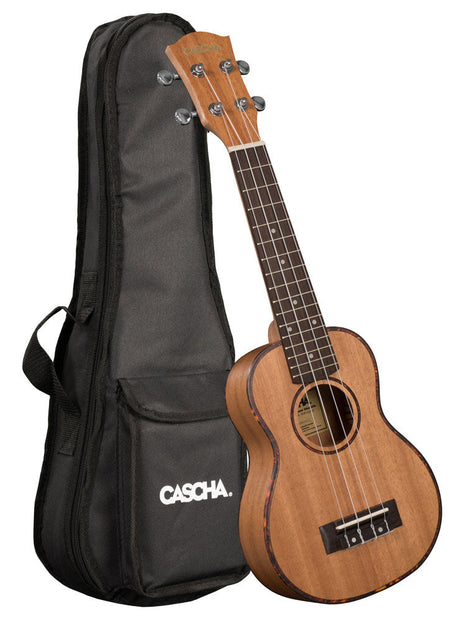
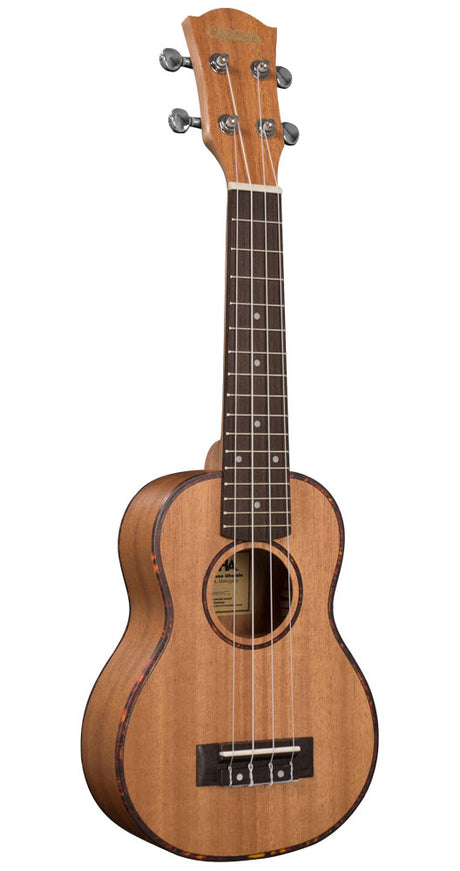
CASCHA HH2026 soprano ukulele – mahogany body, Aquila nylon strings
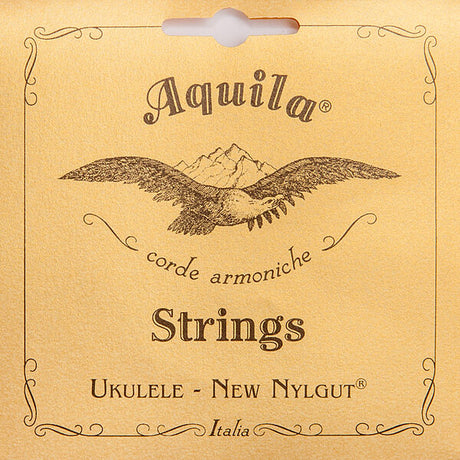
Aquila Ukulele String Set 4U Soprano