

Whether a soundboard or speakers deliver the more natural piano sound does not depend on price, but on the principle of sound output. Modern keyboard instruments often generate their tone digitally, yet they deliver it in two very different ways.
One design lets the wooden soundboard of the piano vibrate itself, turning the instrument body into the sound source. The other uses a tuned multi-channel speaker system that recreates the spatial sound of a concert grand. Both sound good, but differently, and each suits different listening habits.

The instrument body itself becomes the speaker
Ideal for: Anyone who wants to feel a real piano vibrate and keep an acoustic instrument.
See all Klaviere - Neu →A tuned speaker system recreates the grand piano spatial sound
Ideal for: Anyone seeking a tuning-stable, always adjustable grand piano sound without strings.
See all Klaviere - Neu →01How the soundboard becomes the sound source
With the soundboard technique, as Yamaha uses it in the TransAcoustic system and Kawai in the AURES system, there are no visible external speakers. Instead, a so-called transducer sits on the piano soundboard. This transducer translates the digital tone signal into fine vibrations and drives the large wooden body, the very surface that carries the sound on every acoustic piano.
The result is a sound that does not come from a box, but from the instrument itself. The soundboard vibrates, the cabinet resonates slightly, and the tone spreads through the room like an acoustic piano. Important: on a TransAcoustic piano the strings remain in place. You can play it as a perfectly normal acoustic piano at any time, while smoothly turning the digital sound volume down, all the way to headphone-only playing.


02How multi-channel speakers build the grand piano spatial sound
Pure hybrid instruments without strings, such as Yamaha's AvantGrand range, take the opposite path. Here there is no vibrating soundboard anymore, but an elaborate speaker system. In the AvantGrand N1X a multi-channel speaker system with several ways for bass, mids and highs works together, fed by recordings captured at several points of a concert grand soundboard.
This does not play back a single sound, but builds a three-dimensional spatial sound: the tone comes from various directions, just as a real grand radiates from different points of the strings and soundboard. The advantage of this approach is consistency. A stringless hybrid stays tuning-stable, its volume is adjustable at any time, and it always delivers the same concert grand sound, regardless of room, weather or tuning.
03Which one sounds more natural
Natural here is not a verdict, but a matter of definition. The soundboard path sounds natural in a physical sense: you do not just hear the tone, you feel the instrument vibrate, and the sound behaves in the room like an acoustic piano. Anyone who values an instrument that lives and breathes will feel at home here.
The multi-channel speaker path sounds natural in a faithful sense: it deliberately recreates the spatial sound of a top concert grand, with a depth and layering that a single sound body cannot produce. In return you give up the acoustic self-resonance. A rough rule of thumb: anyone who wants to keep a real piano and only practise quietly is right with the soundboard transducer. Anyone seeking a low-maintenance, always identical grand sound is right with the speaker hybrid.
| Feature | Soundboard transducer | Multi-channel speakers |
|---|---|---|
| Examples | Yamaha TransAcoustic, Kawai AURES | Yamaha AvantGrand, Kawai Novus |
| Sound source | vibrating soundboard | tuned speaker system |
| Strings present | yes, stays acoustically playable | no, pure hybrid |
| Sound character | physical, room-filling | faithful grand spatial sound |
| Tuning needed | yes, like an acoustic piano | no, stays stable |
| Volume adjustable | yes, down to headphones | yes, down to headphones |
04A special case: modeling beyond the recording
Alongside recording-based systems, which Yamaha and Kawai mostly use, there is a second sound approach: modeling. Manufacturers such as Casio with the Celviano Grand Hybrid and Roland compute the sound in real time from a physical model of the instrument, instead of playing back finished recordings. Through the speakers you then hear not a frozen recording, but a tone created fresh each time, which responds more finely to touch and pedal play.
For the soundboard or speakers question this changes nothing about the principle: modeling hybrids also deliver their sound through a speaker system. The difference lies in where the tone that feeds the speaker comes from. Anyone who wants to dive deeper into stringless hybrid instruments will find the designs explained in detail in our article on hybrid pianos.
Soundboard or speakers is not a question of better or worse, but of listening experience. The transducer path keeps the piano acoustically alive and lets it vibrate, the speaker path delivers the spatial sound of a concert grand consistently and without tuning effort. The safest way to decide is to hear both worlds side by side.
Frequently asked questions
What is the difference between TransAcoustic and a speaker hybrid
Does a TransAcoustic piano need speakers
Which approach sounds more natural
Does a TransAcoustic piano stay a real piano
Do I have to tune a speaker hybrid
Compare the sound worlds
From the TransAcoustic piano with a vibrating soundboard to the stringless hybrid with multi-channel sound: the range of new pianos shows both output principles.
Browse new pianosYamaha YUS-3 TransAcousticPassende Produkte
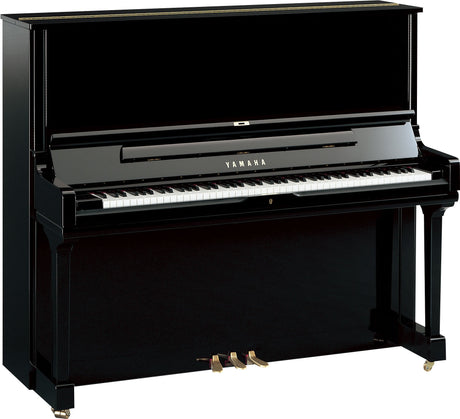

Yamaha YUS-3 Upright Piano in Polished Ebony with TA3 Transacoustic System

