

A capo raises a guitar key without your fretting hand having to move – you clamp it onto a fret and play your familiar chord shapes in a new position. That is the theory. In practice, choosing the right capo decides whether the guitar stays in tune afterwards or whether individual strings buzz and drift.
The most common mistake is putting any capo on any guitar. Steel-string, classical and 12-string guitars have differently shaped fretboards – and that is exactly what decides which type fits. This guide matches the main designs to the guitar types.
01What a capo does – and what actually matters
A capo shortens the vibrating string length by pressing all strings down at one fret. That raises the pitch by one or more semitones without you having to learn different chords: an open G becomes an A with a capo on the second fret, while the fretting hand stays in its familiar shape. Singers use this to match a key to their vocal range without rethinking the accompaniment.
For this to work cleanly, the capo has to hold every string down with even pressure – too little lets strings buzz, too much pulls them out of tune. This is where the designs differ, and this is where the shape of the fretboard comes in.
02The three designs: spring, screw and lever capo
Spring capos (or quick-change capos) are the common standard. A spring holds the tension, fitted with one hand and moved in seconds – ideal when the key changes between songs. The pressure is fixed and cannot be fine-tuned, which is perfectly fine on most guitars.
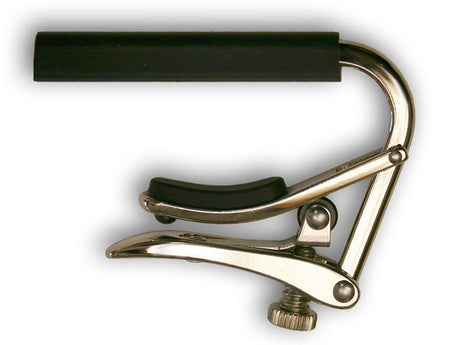
Screw capos such as the Shubb models use an adjusting screw and a lever mechanism. The pressure is set once for the guitar and then stays constant – this gives even pressure across all strings and therefore less drift. A little slower to move, but more precise, especially on more delicate instruments.
Lever capos tension via a side lever and sit very firmly. They are robust and quick, but tend to apply the strongest pressure – on softer classical guitars that can be too much.


03Fretboard radius: curved or flat – the decisive detail
The most important and most often overlooked point is the curve of the fretboard, the radius. Steel-string acoustics usually have a slightly curved fretboard – the matching capo has a curved pad that follows the curve and reaches every string evenly. Put a flat capo on a curved fretboard and it presses too hard at the edges and too softly in the middle.
Classical and nylon-string guitars have a flat, wider fretboard. They need a capo with a straight, wide pad. That is exactly why many makers offer separate steel and nylon versions – they differ not in the mechanism but in pad shape and width.
| Guitar type | Fretboard | Matching pad | Example model |
|---|---|---|---|
| Steel-string | slightly curved | curved, narrower | Shubb C1 / Kyser steel |
| Classical (nylon) | flat, wide | straight, wider | Shubb C2 / Kyser nylon |
| 12-string | curved, wide neck | extra-wide, higher pressure | Shubb C3 |
04Steel-string: the curved screw or spring capo
For a classic steel-string acoustic, a model with a curved pad is the safe choice. The screw capo SHUBB C1 Kapodaster für Stahl-Saiten Gitarren sets the pressure exactly to your guitar and keeps the tuning especially stable – sensible if you play with a capo a lot and want to avoid drift.
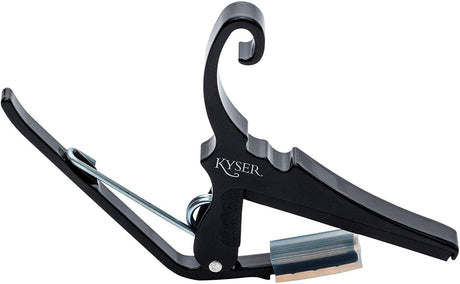
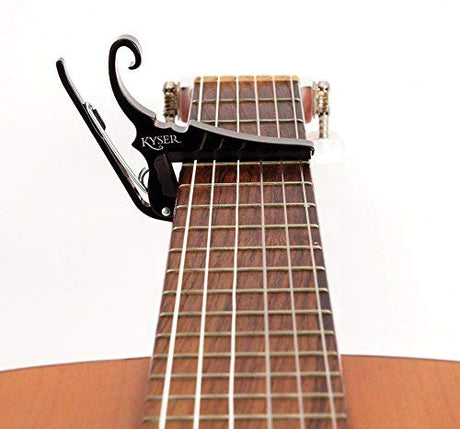
If you want to switch quickly between songs, a spring capo like the Kyser Kapodaster Quick-Change für Stahlsaiten works well: fitted one-handed, moved in seconds. Both are designed for the curved steel-string fretboard.

05Classical and nylon: flat, wide pad
Classical guitars need the straight, wider version. The SHUBB C2 Kapodaster für Nylon-Saiten Gitarren is the nylon version of the screw mechanism – flat pad for the level fretboard, even pressure across the full neck width. If you prefer quick one-handed changes, the spring capo Kyser Quick Change Kapodaster für Nylonsaiten is the quick-change version for nylon strings – with a straight pad for the flat fretboard.

0612-string: extra-wide and more pressure
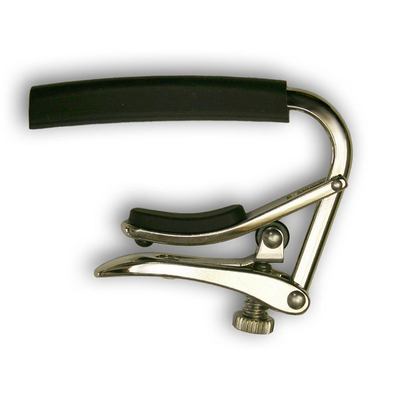
The 12-string guitar is the special case. Six string pairs on a wider neck mean more string pull and a larger area the capo has to hold down evenly. An ordinary six-string capo often is not enough here – individual strings of the pairs then buzz. The SHUBB C3 Kapodaster für 12-Saiter Gitarre is built exactly for this with a wider pad and higher pressure.

The choice is simpler than it first seems: spring capo for quick changes, screw capo for the most stable tuning – and the pad has to match the fretboard. Curved for steel strings, flat for nylon, extra-wide for the 12-string.
Frequently asked questions
Does a capo put the guitar out of tune?
Do I need different capos for nylon and steel strings?
Where on the fret do I place the capo?
Does a guitar capo work on a ukulele?
Find the right capo
All models for steel-string, classical and 12-string guitars at a glance.
All caposShubb C1 for steel stringsPassende Produkte
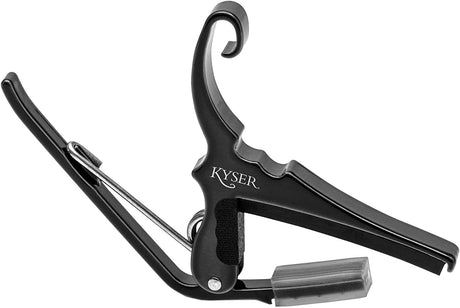
Kyser capo quick-change for steel strings
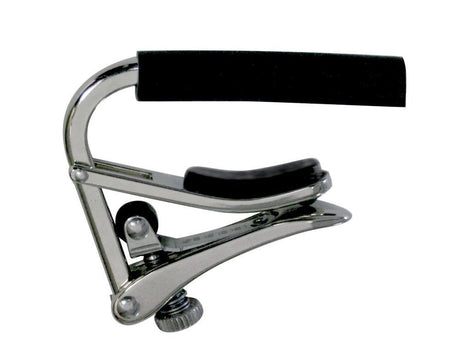
SHUBB C1 capo for steel-string guitars
SHUBB C2 capo for nylon-string guitars
SHUBB C3 capo for 12-string guitar