

String gauge is, alongside the string material, the most important choice when buying strings for an acoustic guitar. It describes the thickness of the thinnest string in thousandths of an inch: a 010 set has a high E string of 010, while a 013 set is noticeably thicker.
Gauge decides how loud and full the guitar sounds, how easy the strings are to press down and bend, and how much pull sits on the neck. This guide explains the four common gauges 010, 011, 012 and 013, and which one suits which player.
01What gauge actually means
Acoustic string sets are named after their thinnest string. A set marked 010 to 047 has a 010 string on top and a 047 on the bottom; a 012 to 053 set is thicker throughout. In everyday use the first number is enough as shorthand.
Four gauges cover almost every need: Extra Light starts at 010, Custom Light at 011, Light at 012 and Medium at 013. The larger the number, the thicker the string, the more material vibrates and the more tension is created.
One thing up front: these gauges apply to the steel strings of an acoustic guitar. A classical guitar is chosen not by gauge but by tension (normal, medium, high). When it comes to a classical guitar, tension is the right term, not gauge.
02What gauge does for tone
Thicker strings move more mass and drive the guitar top harder. The result is more volume, a fuller sound with stronger bass and longer sustain. A Light or Medium string brings out the big, carrying tone of a dreadnought or jumbo.
Thinner strings sound quieter, leaner and often brighter. They respond quickly and emphasise the highs, but deliver less bass and less sustain. On a smaller guitar or for delicate fingerstyle accompaniment, that can be exactly right.
Rule of thumb: if you want fullness and volume, go thicker. If you want a fine, easily responsive tone, go thinner.
03What gauge does for playability
Thinner strings are easier to press down and easier to bend. That spares the fingers, makes barre chords easier and makes bends effortless. For beginners whose fingertips are not yet toughened, and for fingerstyle playing, that is a real advantage.
Thicker strings put up more resistance against both the fretting hand and the picking hand. It feels harder at first, but rewards energetic strumming with stability and tone: the string gives way less under the pick and stays clean even when hit hard.
Rule of thumb: easier playing means thinner, more substance under the fingers means thicker.
04What gauge does to the neck
Every string pulls on the neck and top. A thicker set noticeably increases the overall pull compared with a thinner one. Going from 011 to 013 clearly changes the load on the instrument.
So a change of gauge may call for a setup. The neck bows more under greater tension; the truss rod and possibly the action need readjusting so the guitar does not buzz or sit too high. Within the same gauge, a string change is uncritical.
If in doubt, first stay with the gauge the guitar shipped with, or have the guitar checked after a large jump.
| Gauge | Name | Tone | Feel | Best for |
|---|---|---|---|---|
| 010 | Extra Light | lean, bright, quieter | very easy to press and bend | beginners, sensitive fingers, fingerstyle |
| 011 | Custom Light | balanced, a touch more fullness | easy, a good compromise | beginners and all-rounders |
| 012 | Light | full, balanced, carrying | a little more resistance | standard for most acoustics |
| 013 | Medium | loud, powerful, lots of sustain | firmer, demands the fingers | energetic strumming, large bodies |
05Which gauge suits whom
Beginners and anyone after the lightest possible feel are best served by 010 or 011. The fingers adapt faster, chord changes come easier, and the slightly leaner tone is no drawback while practising. These gauges also suit delicate fingerstyle well.
If you strum a lot and hard, play a large guitar or want a full, loud tone, 012 or 013 serves you better. 012 (Light) is the proven standard for the vast majority of acoustic guitars and a safe starting point. 013 (Medium) is the reach for maximum drive, but needs strong fingers and suits larger bodies best.
Two sets to orient by: a light, easy-playing set like the D'Addario Saiten für Akustikgitarre, 80/20 Bronze for an effortless feel, and a classic Light set like the {{produkt:authentic-acoustic-superior-performance-sp®-westerngitarre-phosphor-bronze-saitensatz}} for a full standard tone. More options and gauges are in the Westerngitarren - Saiten.


String gauge is a simple lever with a big effect: thinner means easier to play and leaner in tone, thicker means louder, fuller and firmer under the fingers. For starting out, 010 or 011 is the comfortable choice, 012 the proven standard, 013 the reserve for energetic playing on large guitars.
Frequently asked questions
What does 010 or 012 mean on guitar strings?
Which string gauge is best for beginners?
Do thicker strings really sound louder?
Do I need to adjust anything after changing gauge?
Does this apply to the classical guitar too?
The right gauge for your acoustic guitar
From Extra Light to Medium, in 80/20 bronze and phosphor bronze: sets for every playing style.
Browse acoustic stringsD'Addario 80/20 BronzePassende Produkte
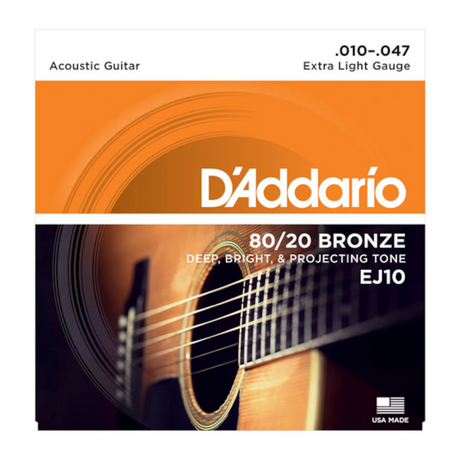
D'Addario Strings for Acoustic Guitar, 80/20 Bronze - 10/47

