The living situation often shapes a purchase decision more than any spec sheet: a rented flat, thin walls, a neighbour directly below, a child's room that doubles as a practice space. In these cases, a digital piano is usually chosen not for its sound alone but because it solves volume, space and consideration all at once. This article does not compare models against each other; it addresses the situation itself: how loud a digital piano really is, what headphone practice actually delivers, how much space it truly needs, and how to place it so that neither neighbours nor housemates are disturbed.
01How loud is a digital piano really
Unlike an acoustic piano, the sound of a digital piano is generated electronically and controlled with a volume dial, from nearly inaudible to room-filling. That is the key difference for apartment living: the volume can be adjusted to the time of day at any moment without changing anything about the instrument. During the day, the built-in speakers are plenty for normal practice; in the evening, or in a flat with thin walls, the level can be turned down so far that almost nothing carries outside the room.
One point matters for a realistic assessment: even at low speaker volume, forceful playing still transmits some structure-borne sound through the cabinet and floor, much like knocking on any piece of furniture. For completely silent practice, switching off the speakers and using headphones removes that too; what remains is only the light clatter of the keys themselves, barely noticeable on most models.
02Headphones: the real solution for quiet practice
For apartment living, the headphone jack often matters more than the speakers. As soon as headphones are plugged in, most digital pianos automatically mute the built-in speakers, so practice becomes completely silent for everyone else in the home. Two headphone outputs are useful when a parent and child sit at the instrument together, or when a teacher wants to listen in.
For the headphones themselves, it is worth choosing a model built for extended playing rather than casual music listening: light weight, padded ear cups and a balanced sound across the full range. The Yamaha Kopfhörer HPH-150 is built for exactly this purpose. For a complete starter setup for the flat, the Casio PX-S1100 Schwarz Deluxe Bundle mit Ständer, Pedalen, Bank und Kopfhörer already includes a stand, bench, pedal unit and headphones.


03Footprint: how much space a digital piano really needs
In many flats the corner meant for an instrument is already fixed, and often narrower than expected. A slim digital piano without a fixed cabinet can, if needed, be stored upright or slid aside on a simple stand when not in use. The Casio PX-S1100 Schwarz Deluxe Bundle mit Ständer, Pedalen, Bank und Kopfhörer is among the thinnest designs on the market and fits into rooms where a traditional console-style digital piano would feel too bulky.
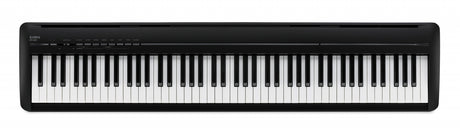
For anyone who prefers a flexible, portable setup over a piece of furniture, perhaps because the practice spot shifts depending on the time of day, a compact stage piano such as the Kawai Stagepiano ES 120 - schwarz sets up on an X-stand and packs away just as easily. The Digitalpianos category gives an overview of all the compact and console models.

04Neighbours and structure-borne sound: placement matters too
A large part of what actually bothers neighbours does not travel through the air but through the floor: structure-borne sound carried through the feet and the screed, especially in multi-unit buildings with a neighbour directly below. Two simple measures help regardless of the instrument: a damping mat under the stand or the unit's feet, and some distance from a shared wall instead of direct contact.
For placement itself, it helps not to push the instrument into a corner but to leave some space from the wall, which benefits both the sound of the built-in speakers and vibration transfer. Anyone practising regularly later in the evening is best served by combining the reduced speaker volume from the first section with headphone practice.
05Considerate practice times in an apartment
Beyond the technical side, a simple organisational routine helps a lot: fixed, announced practice times in the afternoon or early evening using the speakers, and headphones as standard for earlier or later sessions. In most multi-unit buildings, that alone removes a large share of potential friction, without any structural measures. Anyone moving into a flat with an instrument benefits from a brief chat with direct neighbours about usual practice times, which in practice builds more goodwill than any soundproofing.
For an apartment, it is rarely the loudest or largest instrument that matters, but the one whose volume can be controlled, that practises completely silently with headphones, and that fits into the available space. Once these three points are settled, the actual purchase decision usually becomes independent of the specific model.
Frequently asked questions
Can you hear a digital piano through a wall
Is headphone practice enough for everyday use
How much space does a digital piano need in a small flat
What helps against disturbing structure-borne sound while playing
Find the right digital piano for your flat
Compact, with a headphone option and suited to small rooms: an overview of the current digital pianos.
Browse all digital pianosDiscover the Casio PX-S1100 bundlePassende Produkte




Casio PX-S1100 Black Deluxe Bundle with Stand, Pedals, Bench and Headphones