

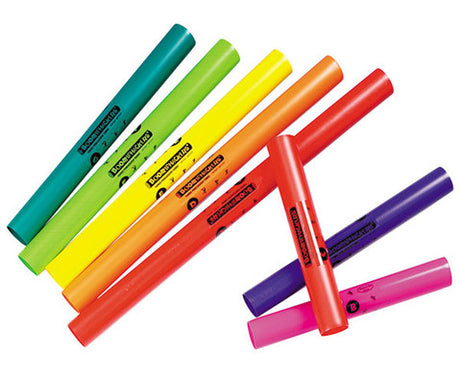
Boomwhackers are colourful plastic tuned tubes that anyone can sound straight away: tap one against your hand, the floor or your thigh and it rings out a single note depending on the tube. That very simplicity is what makes them such a popular starter instrument in schools, daycare and at home.
In this guide we explain what boomwhackers are, how the colour-and-length principle works, which sets exist and how to play the tubes solo or in a group.
01What are boomwhackers?
Boomwhackers are tuned percussion tubes made of lightweight plastic. The name describes the playing principle itself: "boom" is the note produced on impact, and "to whack" is the act of striking. Each tube is tuned to a fixed note and assigned a colour.
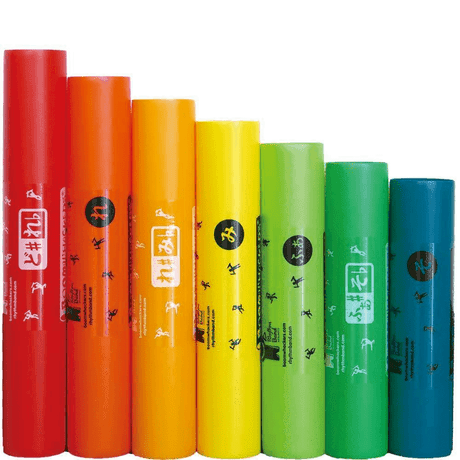
Length is what matters: the shorter the tube, the higher the note; the longer it is, the lower. Strike the tube on different surfaces and only the tone colour changes — the pitch stays the same. The material is sturdy and long-lasting, which makes the tubes ideal for daily use with children.

02The colour system: why each tube has its own colour
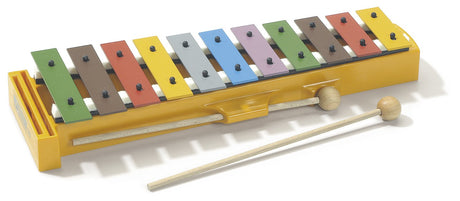
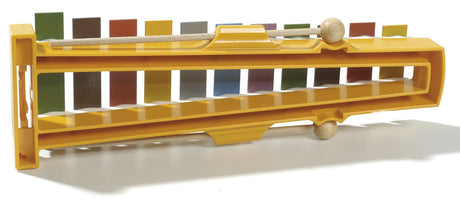
Each note on a boomwhacker has a fixed colour — C is red, D orange, E yellow, and so on. This colour system is no accident: it is the same scheme used by many colourful Sonor - GS Kinder Glockenspiel and other Orff instruments. Once you know one colour world, you instantly find your way around the other instrument.
For teaching this is a big advantage: notes can be conveyed through colours instead of standard notation. A colour-coded score is enough for a whole group to play a song together, without having learned to read music first.
03Diatonic, chromatic and Octavator caps
The basic diatonic set has 8 tubes and forms the C major scale: c1, d1, e1, f1, g1, a1, b1, c2. Depending on the note, the tubes are roughly 30 to 63 cm long. This set alone covers many children's songs.
If you need more notes, add a chromatic set of 5 semitone tubes. That gives you every semitone. Octavator caps push onto one end of a tube and make the same note sound a full octave lower — extending the range downward without needing longer tubes.
| Set | Tubes | Notes | What for |
|---|---|---|---|
| Diatonic (C major) | 8 | c1, d1, e1, f1, g1, a1, b1, c2 | getting started, children's songs |
| Chromatic (add-on) | 5 | 5 semitones | all semitones, more repertoire |
| Octavator caps | Accessory | one octave lower | lower accompaniment voices |
04How do you play boomwhackers?
Boomwhackers are struck, not blown or plucked. Hold the tube loosely at the thin end and strike the other end against a surface: your flat hand, your thigh, the floor or the edge of a table. Each surface gives a slightly different tone colour at the same pitch.
The real strength of boomwhackers is group play. Each person gets one tube, so one note, and strikes it exactly when their colour comes around. Many individual notes turn into a shared melody — nobody has to hit every note, everyone contributes one piece. That makes boomwhackers especially valuable for classes, daycare groups and also for use in music therapy as a low-barrier play-along instrument.

05Use in music lessons and at home
In music lessons, boomwhackers are a proven way into rhythm, harmony and melody. Because everyone produces a clean note immediately, playing together takes centre stage from minute one instead of long technique drills. Complex ideas like scales or chord progressions become visual through colour.
At home, boomwhackers are an affordable, robust way to introduce children to making music. They fit well into the Orff world of Orff, combine with glockenspiel, sound bars and rhythm instruments, and survive even enthusiastic constant use.
Boomwhackers are an affordable, robust and instantly playable entry into making music together. The basic diatonic set goes a long way, and a chromatic add-on plus Octavator caps extend the range step by step.
Frequently asked questions
What age are boomwhackers suitable for?
How many boomwhackers do you need to start?
What do the Octavator caps do?
Do boomwhackers follow the same colour scheme as glockenspiels?
Ready for the first notes?
The diatonic boomwhacker set and matching Orff instruments for school, daycare and home.
View boomwhackersExplore Orff instrumentsPassende Produkte


Sonor - GS children's glockenspiel